
Audi could taste their victories at ’86 and ’87 editions of Pikes Peak Hillclimb, with their complex Sport quattro S1 – and since then, they only wanted more. Their American team set their course to Trans-Am championships, but that required them to develop a car that would underline quattro system’s domination – and clear any doubts that may remain, that quattro gave Germans advantage not only on dirt rallies, but also crushed its rivals on racetracks.


The engineers started working on 200 Quattro – internal code: R4. The championship rules allowed a lot, but the body and suspension had to be mostly stock, so they installed a rollcage to increase safety and overall car rigidity. The whole geometry was set up so it could start destroying any possible rivalry.


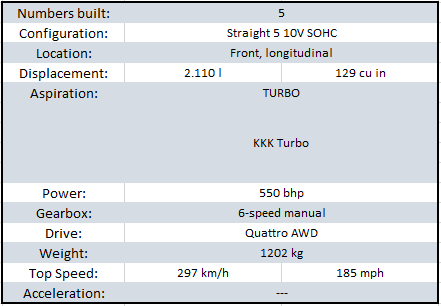
The engine had to be based on the road going motor – otherwise they would never be allowed to start. The natural choice was their Inline 5-cylinder Turbo SOHC. The crankcase was new, the valves were new – and it had additional fuel pump. And that was mostly it! It was enough. The turbo gave it around 3 bars of boost, which allowed the 2.1-litre engine to generate 510 bhp right from the start of the season.


The whole transmission layout was practically 1:1 quattro rally derived, but SCCA disallowed 6-speed gearboxes, so Audi had one blank gear on it. The grande finale was – of course – the quattro system. It included TorSen in the mid section and a separate Limited Slip front and rear.


The Germans had a production-based chassis with fibreglass reinforced bodypanels based on the production car, but the final product didn’t look much like the road legal Audi 200. It was the biggest Audi racecar then: almost 5 metres long and over 2 metres wide! They had to push the driver’s seat 40cm back to fix the weight distribution. That’s almost 1 metre back!


When preparing the car, Audi used the expertise of Bob Tullius and his team – Group 44 – known for working with Jags. Tullius let Hurley Haywood man the machine and, when he could, Hans Joachim Stuck was the second driver… but sometimes he couldn’t, and then, he was replaced by Walter Rohrl – World Rally Championship superstar himself. With such a dream team, Audi (Haywood) managed „only” second place in their first start, but the second event they won fair and square. Haywood, Stuck and Rohrl brought 8 first places combined out of 13 possible, and maybe the finish of the season wasn’t perfect, but Audi had enough points to stay on the very top.


Americans, of course, had to voice their objections targeted against the German machine devouring, at that point, any and every opposition, and SCCA answered: first with raising weight limits from 1.1 to 1.2 tons, and changing airflow regulations after. All in vain as Walter Rohrl, behind the wheel of the machine in its worst configuration, finished first and with the fastest lap.


Americans pressed SCCA enough to finally ban All-Wheel Drive altogether, starting year 1989. Germans said to that: Ok, fuck you then! And they moved to the rival format. IMSA GT Championship allowed even more ridiculous Audi 90 quattro IMSA-GTO, but that also meant the end of the first track car of the German manufacturer. Banned after 1 season, 8 victories out of 13, driver’s and manufacturer’s champion. I think they made their point. Quattro rules!


Krzysztof Wilk
All sources: favcars.com | wheelsage.org | ultimatecarpage.com


 SRT
SRT 