
That car had its debut at Detroit North American Auto Show in 1989 and it literally kicked ass. It was a man machine. An iconic Shelby Cobra spirit incarnate – mean and knowing no compromise. More, in future we will learn it would be, maybe not purely American, but one of the most yankee automobile on the market – with over 75% of its parts made in-house. That’s placing it in top ten in the world. Well, what can you say? Americans can be proud… but it wouldn’t take much for the car to never have existed.


Chrysler Cordoba was fading out in the ’80s and it was an important model for them, cause it really saved their asses in the face of a global crisis. It was to rival Oldsmobiles, Regals and the Cougars on the luxury market, but Chrysler wanted to badge their car as Plymouth Mirada initially. That planned was crossed as quickly as the fuel prices went up, so the mother company decided to fully embrace the new car as a Chrysler. That way, Cordoba gained +5 to prestige, and the Chrysler marketing tools did good job as well. Happy days – and Chrysler people could put the ropes back on the shelf this time.


Cordoba was a success, but it had its toll. It did eventually manage to keep the company on the surface, but it was going against its own family. Dodge Charger SE, though cheap, looked like shit compared to the fancy new cousin. Not to mention all the under-equipped smaller luxury vehicles like Plymouth Fury and Dodge Coronet – all that couldn’t ever match Chrysler comfort levels or prestige. That’s how LeBaron was born – it was to clean up the mess in that segment in the late ’70s.


It got a facelift and a completely new front wheel-drive platform – yet LeBaron still remained the cheapest luxury car on the market then. Chrysler started offering those cars as convertibles – first like that since the Eldorado – and the richer dads with families could buy fresh Town and Country station wagons. The cheap LeBaron kept coming with more interior options and the bigger Cordoba was losing attention to the point that it’s factories were shut dead with the end of 1983.


Chrysler said goodbye to the models like Fifth Avenue – which started as a trim for the LeBaron, but grew big enough to get its own series – Dodge Diplomat and Plymouth Gran Fury – both of which were closely related to New Yorker, Fifth Avenue, and by definition, with the LeBaron. To put it simple: boring, boring and more rebadged boring – in a different package. The head of the Chrysler business was Lee Iacocca, and he tried to be a smartass. He had a plan to give a fresh tone to the Chrysler name.


Lee was a chairman of a big corporation himself and with the legendary De Tomaso brand owner – they were good friends. Alejandro de Tomaso was an ex-F1 driver and the mastermind behind the De Tomaso Pantera sportscar. And privately – he hung with his pal Iacocca. At times they were discussing new ideas: one of them was a Reliant-based Mercedes luxury roadster. It didn’t happen, but what did happen was they had plans for what was to be a completely new product in Chrysler line-up: the one to change everything upside down and bring new clients to their dealerships. The target was: young people, full of energy and with money. Such that would look for a Buick Reatta sort of car, or a Cadillac Allante. That way Chrysler TC came to be – and let’s face it, it was gutless. It was the definition of bland. The cheap LeBaron similarities were striking, and it had nothing to make up for it. It was under-equipped compared to the LeBaron and it cost bigger money – while you could at least get some sportier versions of the LeBaron. Chrysler planned to craft the TC in 10,000 examples every year, but the production stopped after exactly 7300 – and only because that was the deal. Chrysler just burnt 600M dollars – SIX HUNDRED MILLION – that’s how much the development cost. They had to spend 80 thousand to produce one vehicle of that sort. I don’t think I have to say there was no image change coming with it, do I? In order to achieve that, they had to try a different approach…


Bob Lutz was the owner of the Chrysler corporation then, and he once shared his ideas with Tom Gale. Gale was working in their design facility and Lutz asked him: ‚Hey, Bob. What if we made a, you know… a Shelby Cobra? Essentially… I’m just thinking, yeah? Like if we, hypothetically, made a Cobra, yeah? But today. So – im not suggesting anything, ok… but how would it look like? To you. And remember: if you put some shit motor in it, you’re fired.’ Gale then told him he had to think about it… and he prepared a model of the car. When Lutz saw the car, they made a prototype and sent it to Detroit Auto Show. Fuck me, it was the bomb. People were clapping their ears and chief engineer Roy Sjoberg was redirected to work on the development of a running example. Iacocca though started having TC flashbacks – he just threw 600M down the toilet, remember? – and as the chairman… afraid of the risks of the new project, he held the financing. It wasn’t a car for everyone, with high chance it would never be cost effective. The Pope adviced patience.


Sjoberg took over Team Viper: an exclusive group of 85 engineers – all volunteers – and with one focus… secret development of a killer sportscar. Sjoberg told his guys:
– We got that 70M promised, but we can’t spend it just now, so if anyone asks, we ain’t doing nothing – he said.
– But we are working on a project…
– Yes, we are – but if anyone asks, if there are questions – We not doing anything.
– Ohh… If anyone asks, we not working… Because, in fact, we are working. But if anyone asks, we aren’t. Got it!


He finally got his money and started making calls. He spoke to Lamborghini first – it belonged to Americans then – and he made a request for new motors for the prototypes and production cars’ engine blocks. He had 70M dollars to make a car from scratch. It really was nothing, so Team Viper used the worst crap they could find in their cheapest cars, and with that waste they finished the interior. They had only one goal: the car had to be fast. Anything else was irrelevant. They didn’t think much about glovebox, or any other passenger amenities. There was no such bullshit in their car. Air condition wasn’t even in their plans, and the car didn’t have electric windows… frankly, they didn’t put the windows in at all! Why, who needs them? No windows, no roof, not even doorhandles. What it had was performance. The bucket seats and, if you had the money, adjustable suspension. It was a proper Cobra-style roadster – and quick as fuck!


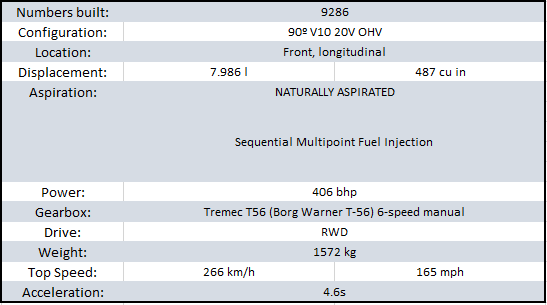
Lamborghini delivered 400-horsepower V10s, that – when put under the hood of a 3300-pound car the size of a Miata – could be an immediate threat on the road. You could start driving on 3rd gear and you know what? Actually… the transmission, when driving in low RPM, would go from 1st to 4th without asking. Not everyone can drive this thing. It’s not really hard when you’re careful, but faster corners are incredibly demanding, and it takes a lot of skill to do it. And bare this: Viper drivers die like real men. No airbags, no heatseeking guidance systems. What… you thought that rollbar would save you from death? Pfff… forget about it! The car is like a friend who’s got wasted and – you’re having some laughs together at the party – by when you’re stopped by some dudes on the way home, he’s looking for some heat. And you know you can drive normal – you’re not in hurry. But you got an 8-liter V10 under the hood. 400 horsepower. And it’s testing you. “Well, go hit it – you think I can’t take it? You know I can. Just wait and see. You know what’s gonna happen. Go step on it – you know me…” and then you step on it…


There is a very thin line separating a sportscar from a serial widowmaker. The edge, many automakers in the history were carefully closing in to. Dodge shows at the place, kicks the door open, shits in the middle of the room, giving everyone the finger on the exit. They don’t make such cars anymore. No one will. Even later Vipers – tremendous sportscar’s, extremely effective on a racetrack – year by year they strayed further from god. Early GTS variants from 1996 got a fixed roof already and an Aircon. It was still a daring coffin on wheels – but more practical at that which takes away some of its brute charm. Even though each next generation was more powerful and more lightweight at the same time – it could forgive more driver mistakes. The fastest variants held the Nurburgring time and the dealerships had several special editions waiting the clients. 1998 Let Mans went to Dodge – GTS-R Group 2 was best AND second best in its class. But it wasn’t enough… they year after they came for first 6 positions! No point bringing all their wins now, cause the list goes from here to San Francisco. Dodge was best in GTS class DAILY – they could win 16 events out 18 possible. That model dominated GT Endurance formats. It took podiums on every track of the world. Often standing on the first spot.


It was a huge leap of faith for Lee Iacocca. Burning money for a project so bold, so short after a devastating TC disaster that shook his self esteem to the bits. It must have been a huge test for him. It worked perfectly this time – and after many years, Iacocca gave America a car… THE CAR to fight Corvettes again – just like Shelby Cobra did. Viper does 0-60 in 4.5 seconds and transfers all the tiniest road imperfections straight on the steering wheel precisely. Yes, it asked for a strong grip on the wheel and nerves to drive it, but it did quarter mile in less than 13s from the factory, and 200 km/h (120 mph) is reached after 17 seconds. From the factory. No traction control, no ABS – none of this crap. Such character we will not find in any car today, and the brute, crude nature we know and love this car for. Viper wins races for 26 years until the last examples exit Dodge factory in 2017.


Krzysztof Wilk
All sources: ultimatecarpage.com | favcars.com | wheelsage.org | wikipedia.org | hotcars.com | rallyways.com | motorsportmagazine.com | netcarshow.com | hotcars.com | supercars.net | carscoops.com | YT: Doug DeMuro | YT: Donut Media | YT: Z Innej Perspektywy


 SRT
SRT 