

Late ’80s Germany and Volkswagen presents their most expensive project in history – the Corrado. What, what, what?! The Corrado?! Yes. The Corrado. It was intended to replace Italdesign Giugiaro-designed model Scirocco, but the new Volkswagen was to be more modern and far superior in its core design. The bodies were ordered from Karmann, as the cooperation between both companies was long lasting at that point already: with the iconic Karmann Ghia as a perfect example. Half million and more of these cars came from their workshops since 1955. Great success. Karmann took part in Scirocco’s arrival – both 1st and 2nd generation – so one might say they know their business.


New Corrado was a VW Golf sports derivative, using its MK2 platform. It inherited its wheelbase and most of the internals, but the torsion-bar rear suspension was shared with the Passat. Corrado wasn’t the prettiest car on the market, but it’s slant nose and wide ass helped maintaining beneficial drag coefficient at the level of 0.32. Early Golf GTI powertrains – those were 1.8 16V – generated stable 136 bhp, and they were quickly assisted with a G60 motor (an 8-valve supercharged). Both maybe good for boiling water, but not for driving really. You had to step on it for at least 8 seconds to actually reach 60 mph… but the acceleration is not why people love these cars. They handle so great so that Autocar magazine dubbed them one of the best front-wheel drive models of all time. CAR, on the other way, said Corrado is one of the 25 cars everyone should drive at least once before they died.


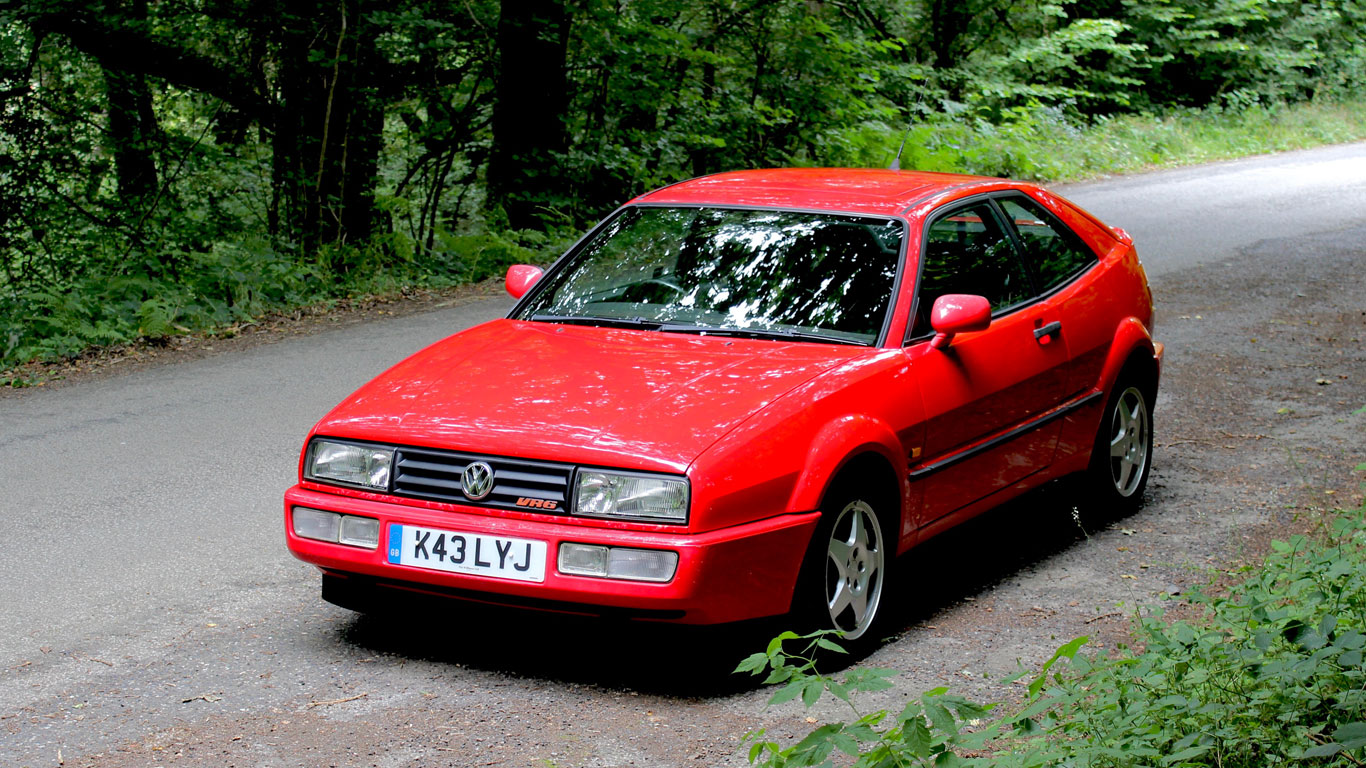
Its underpowered motor was very detrimental, that’s why the Volkswagen failed to attract the amount of clients that would satisfy their sales department. The real change came with the year 1992, when they revised their powerplants. The whole thing was – they tried to find a way to put enough zylinders in, so that it accelerates – but packed in a way they could all fit the transverse layout. Hence: Vee Reihenmotor. An inline V. Not really a new concept. The 1920s airplanes flew on Lancia’s motors in the VR layout – and the real beginnings could be traced even 40 years further back… yet – till that point nobody experimented on cars, really. Germans made a V6 engine with such a sharp, 15 degree angle, to help cover all rows of cylinders under one head. In size, it was comparable to a Straight 4. The new compact engine made its debut in 1991 Geneva salon, where it sat under the hood of the new VR6 Passats. Such config could make 190 bhp from 2.9-litre which allowed for 6.5 second acceleration. You know what did 6.5 in 1992? Porsche 968. The faster one, that is – the Club Sport. 6.5 seconds. You’re not far from Escort RS Cosworth from here now. It’s the same territory. And mind this: there were no V6es on the market, nor any Turbo Straight 4s, that could match VR6 in its smoothness, mid range power delivery, or the feast-for-the-ears sound experience the VW offered.


The power was sent to a 5-speed. Fast and precise. The suspension was the bomb. It was smooth and handling – perfectly predictable. Instantaneous and accurate response for any steering wheel movement. No torque steer – even though it was a front-wheel drive. You could start feeling some only under hard acceleration. The ride was smooth and refined. Firm and sporty, but the suspension cushioned most bumps of the road. Very Golf-like, you could say. A trait inherited from the GTIs. Honestly – it did share a significant amount of components with the MK3 platform. It had a wide front track, which then led to further changes in aero design. Both front and rear were reinforced, and the spoiler in the back appeared. It was retractable, hidden during slow corners, and erected when in high speeds, giving that tiny bit of extra stability. And yes, you could say that even the likes of Fiesta ST were closing in – in terms of acceleration – but there was no match for Corrado when we speak about pure handling experience. The car is communicative, with a gearbox eager to always push it further, and engine that smoothly allows fun instead of violently pressing you against the driver’s seat.


The Volkswagen, with its Corrado, boldly steps in the market territory of such iconic cars like the Calibra, Celica, Ford Probe or the Prelude. You could argue if the rivals had better cars overall – but they did win the fight in the end. Not 100 thousand of VWs were made – and only a few with the VR engine. The first gen Scirocco alone made such numbers 5 times. Maybe the market situation didn’t reflect its value, but the Corrado was, in fact, better from almost every angle. VW body could fit 2 adults in the back, while being shorter than any of its rivals’! The front seats gave good level of comfort – enough for long distance travel. Well-planned interior design was more than just practical and fuel consumption: reasonable at least. Not to mention its splendid powertrain the amazing driving experience.


In the humdrum nowadays of the inline turbocharged motors – such of despicably tiny displacement – the Corrado is a treat. It’s unique architecture stands out in every manner. The car that is not afraid of wild mileage. Even a 30-year-old example satisfies in terms of performance in full rev range, while comfortably seating a man with his family. Practicability, versatility and reliability – and we’re still talking about the car, that is in a rough fight for the title of king of the FWDs – head to head against such rivals as Integra Type R or Lotus Elan. Sadly… there’s only around 2000 of them left in reasonable condition.


Krzysztof Wilk
All sources: favcars.com | wheelsage.org | wikipedia.org | autozine.org | retromotor.co.uk | pistonheads.com | evo.co.uk



 SRT
SRT 