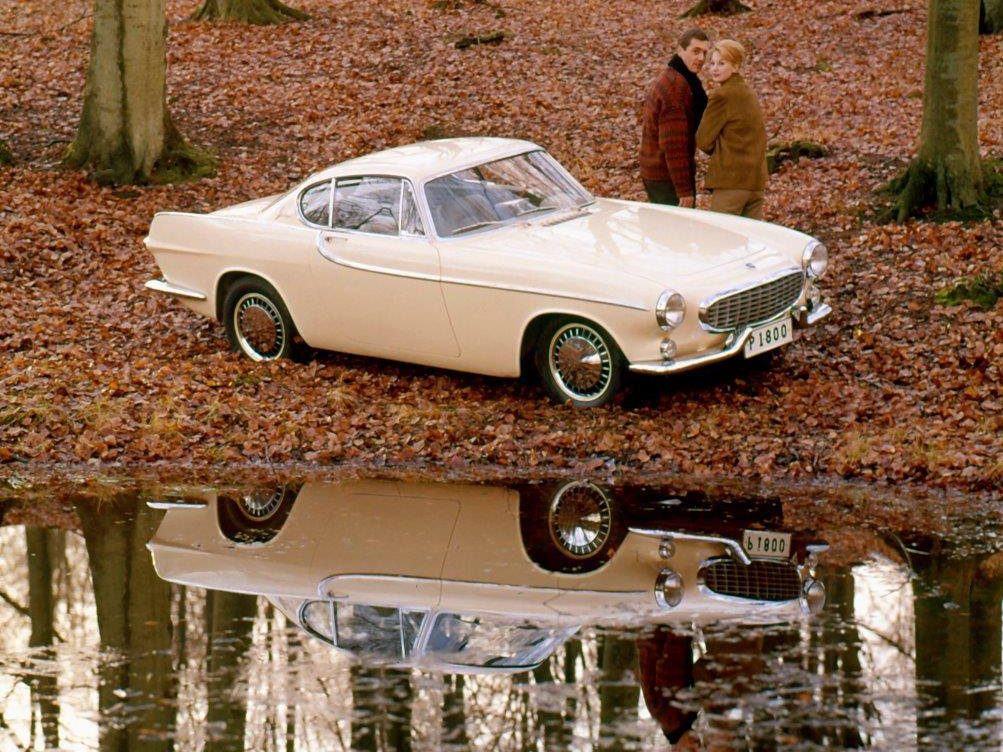
| Engine | Displacement | Power | Acceleration | Top Speed |
| Straight 4 | 1.8-2.0 L | 100-130 bhp | 9.5-14.0s | 166-193 km/h 103-120 mph |
Volvo had a beautiful Frua-penned body, and it became a star of The Saint alongside Roger Moore. The TV fame stuck to the model permanently. Today, hardly anyone remembers the Swedish sports coupe without mentioning that show, but the car itself attracted enormous attention when it was on sale… even though, underneath, its architecture was actually quite conventional. And on top of that – despite Volvo’s reputation for reliability – the early P1800s were built to questionable quality.


I’ll tell you for why: because Volvo simply did not have the production capacity, so manufacturing of the sports model was handed over to the British company Jensen. They received steel bodies shipped in from Scotland – and Volvo itself was practically uninvolved in the whole operation.
Jensen had a contract to build the first 10k cars, but when the Swedes saw the result, they basically said: „Nuh-uh. Nope.” The British managed to build barely 6000 examples, and in 1964, when all production was moved to Sweden, the quality finally improved. Those cars carried the 1800S designation.
The 1800S engine received a higher compression ratio and an improved valvetrain, which meant more power and more speed. Apart from that, it was essentially the same car. The „S” in the name can be misleading, because it had nothing to do with sport. The S stood for „Sverige.” But the Swedish-built car was better put together and, despite being fundamentally the same thing, it was a far better automobile than the early British-built examples.
Displacement did not increase until 1968, when it grew to two liters – although it was still the same B18-derived unit used in the Volvo Amazon. Fuel injection soon followed with the 1800E version (the „E” meaning „Einspritz”), and an automatic transmission became available a year before production ended. This variant could also be distinguished by its alloy wheels.


Because of all this mess, you can end up with two examples of supposedly the same car standing side by side: one built like a tank because it’s Swedish – and the other a piece of shit built in England. It was not a typical sports car. More of a vista cruiser in the style of Aston Martins. Only the front suspension was independent, using double wishbones. At the rear, there was a solid axle with coil springs.
The car was certainly capable of high speeds, but the fully synchronized gearbox with overdrive clearly favoured long motorway journeys in the comfort of a 2+2 coupe rather than drag racing acceleration or brutal sportscar performance – definitely not that. Volvo also equipped these cars properly. The front end had disc brakes with servo assistance, which helped the car handle well and made it very safe.


Safe and comfortable, but that was hardly a surprise… It shared a lot of its mechanical hardware with the 121 and the Amazon – the larger sedan in Volvo’s range. That gave the P1800 plenty strength. Most simply inherited from other models.
It looked Aston Martin, but underneath it was basically a Volvo. It certainly wasn’t cheap to buy, but it was still roughly half the price of the competition. Nearly 50 000 examples of all variants were sold – including the „ES” shooting brake, which was a direct rival to the Reliant Scimitar GTE in Britain – and one of those buyers was the star of the TV series himself. Roger Moore drove one on the set of The Saint, but he also owned a P1800 privately.
The final 1800E examples had a 130-horsepower B20 engine with Bosch D-Jetronic fuel injection, an improved valvetrain, and disc brakes on all four wheels. That setup was already capable of a solid 120 mph and could reach 0-60 in 9.5 seconds. That was more than enough to qualify the car for some proper track action.


By that point, the Volvo was no longer merely keeping up with sports cars from MG or Triumph – it was considerably faster than them. But, well… the platform had grown old. They quickly turned it into an estate, and not long after that the model was withdrawn from production. In Britain, the Swedes mainly lost out to Jaguar, thanks to the E-Type, which was not actually that much more expensive than the P1800 – and the Volvo simply had no chance of matching it in any way.
As I mentioned, the design was handled by the Frua studio – although even there, you can trace some Swedish roots. The son of Volvo’s chief engineer had just graduated from the Pratt Institute in New York, and his father – as part of the „nepotism+” initiative (actually not really) – made sure his son’s proposal reached the final five. Volvo only admitted this in 2008.
In the end, his design turned out to be the best and was selected. Volvo’s top boss at the time chose it because he wanted a car with a purely Italian shape. And all the way through, he approved the production of a model designed by one of their own countrymen while believing it was Italian – because he had no idea, and nobody told him, that the Italian studio had employed a Swedish designer. Frua built three prototypes, all according to the instructions of Pelle Petterson, with whom they worked closely – something Volvo itself did not know at the time.


It may not be the fastest car around, and it may have suffered from the shortcomings of the British-built examples, but it is still one of the better-looking classics – and one of the more accessible ones you can get now for some reasonably humane money. On top of that, it is genuinely fun to drive despite its performance limitations. Rare, attractive, simple to repair, and generally regarded as quite reliable.
One example from 1966 reached 3 million miles (around 4.8 million kilometers) in 2013, setting a new record in the process. That particular car literally outlived its owner. The man passed away five years after setting the record, and by then his Volvo had 3.2 million miles on the clock – and that still was not its final word. A very good car to start your adventure with automotive classics – just please, not Jensen-built, because that really can turn into a road through hell.


Krzysztof Wilk
All sources: it was a text retrieved from my lost webpage – sources will need to be filled later






 SRT
SRT 